
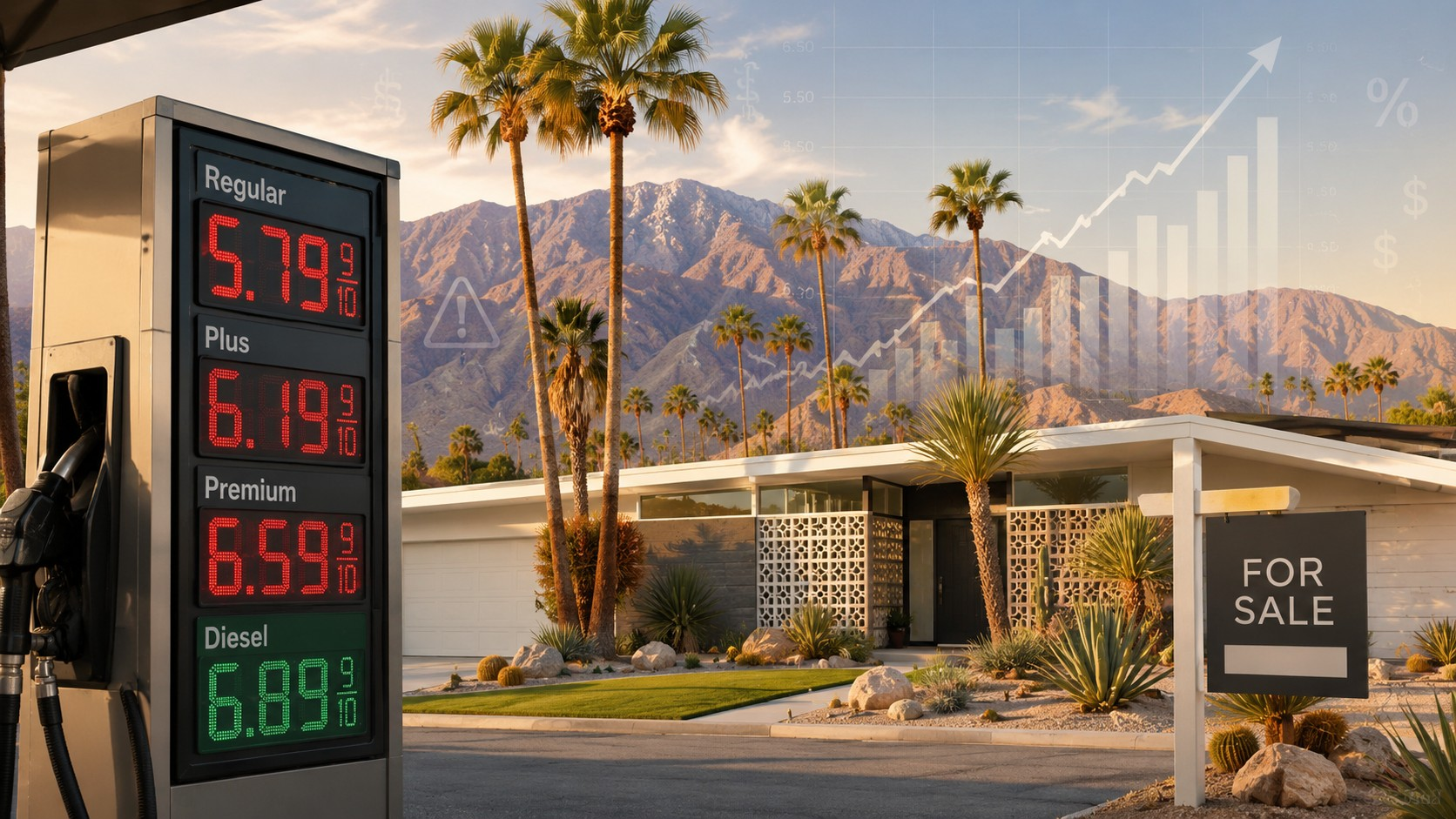
If you filled up your tank this week, you probably felt the sting at the pump. We all have felt the economic impact here at The Paul Kaplan Group in Palm Springs.
Gas prices are rising again as the conflict involving the United States, Israel, and Iran disrupts global energy markets. Oil recently pushed above $100 per barrel amid renewed concerns about attacks, shipping interruptions, and the movement of petroleum through the Strait of Hormuz and the Red Sea.
Although the fighting is taking place thousands of miles from Palm Springs, its financial effects are reaching Southern California households remarkably quickly.
Approximately 20% of the world’s petroleum liquids normally move through the Strait of Hormuz, making it one of the most important oil-transit routes on the planet. When shipments through the strait are interrupted—or even seriously threatened—oil markets begin pricing in the possibility of shortages. Shipping, refining, and insurance costs may also increase. (U.S. Energy Information Administration)
For Palm Springs and Coachella Valley residents, this is about much more than the price of filling a gas tank.
Oil affects transportation, airfare, food distribution, manufacturing, construction, and the delivery of nearly every product we purchase. Higher energy costs can increase household expenses, revive inflation concerns, and influence the direction of interest rates and mortgage rates.
That means a geopolitical crisis abroad can eventually affect how much a buyer can afford to pay for a Palm Springs home—and how much negotiating power a seller has when that property goes on the market.
How Higher Gas Prices Can Affect the U.S. Economy
When gasoline prices rise, households have less money available for dining, travel, home improvements, and other discretionary purchases.
The pressure can be especially noticeable in Southern California, where many people rely on their cars for long commutes and regional travel. A household spending substantially more each month on fuel may postpone a major purchase or become more cautious about taking on a larger mortgage payment.
Businesses are also affected. Trucking companies pay more to transport goods. Airlines pay more for fuel. Contractors incur higher costs to deliver materials and operate equipment. Food becomes more expensive to grow, process, and distribute.
Businesses often pass at least some of those additional expenses on to consumers. That can keep inflation elevated and make it harder for the Federal Reserve to reduce interest rates.
For anyone thinking about buying or selling Palm Springs real estate, that connection matters.
Higher oil prices can lead to higher inflation expectations. Higher inflation expectations can put pressure on Treasury yields and mortgage rates. Higher mortgage rates can reduce what buyers can afford, slow home sales, and increase the need for sellers to negotiate.
Interest Rates: A Year of Waiting
The latest energy shock comes at a difficult time for the Federal Reserve.
During the second half of 2025, the Fed made three consecutive interest-rate cuts. By the end of the year, there was growing optimism that inflation was becoming manageable and that borrowing costs might continue moving lower during 2026.
That expected relief has now stalled.
At its June 2026 meeting, the Federal Reserve maintained the federal funds target range at 3.50% to 3.75%. Policymakers continue to balance the risk of persistent inflation against the possibility that elevated borrowing costs could weaken the economy. (Federal Reserve)
Higher energy prices make that balancing act more difficult.
Even when the Fed wants to encourage economic activity, cutting interest rates while inflation is accelerating can make the problem worse. Lower rates generally stimulate borrowing and spending, potentially adding demand at the same time businesses are already raising prices to cover higher operating costs.
For Palm Springs home buyers and sellers waiting for mortgage rates to decline, this means substantial relief may take longer than originally hoped.
Trump, Jerome Powell and the New Federal Reserve Leadership
The relationship between President Trump and the Federal Reserve has been an important part of the economic narrative.
Trump repeatedly criticized former Federal Reserve Chair Jerome Powell and argued that interest rates should have been reduced more aggressively to support housing, business investment, and economic growth.
Kevin Warsh subsequently became Federal Reserve Chair, creating expectations among some observers that the central bank might move more quickly toward lower rates.
However, no Fed chair can ignore a major inflationary shock.
Even a Federal Reserve leadership team that would prefer lower borrowing costs must consider the potential consequences of expensive oil, higher consumer prices, and renewed pressure on the dollar.
The administration may want lower rates, and the housing industry would certainly welcome lower mortgage rates. But a war-driven surge in energy costs could leave the Fed with fewer options.
If inflation remains elevated, the Fed may keep rates higher for longer. In a more severe inflationary environment, policymakers could even consider additional tightening.
What Is Happening With Mortgage Rates in 2026?
Mortgage rates do not move in perfect lockstep with the federal funds rate.
Thirty-year mortgage rates are influenced more directly by long-term Treasury yields, inflation expectations, investor confidence and expectations about the future direction of the economy.
According to Freddie Mac, the average rate for a 30-year fixed mortgage was 6.55% as of July 16, 2026. That was up from 6.49% the previous week and 6.43% two weeks earlier. (Freddie Mac)
Oil’s latest surge could place additional pressure on mortgage rates by increasing inflation concerns.
This does not mean mortgage rates will automatically move sharply higher. Rates fluctuate based on numerous economic forces. However, it does mean the significant rate relief many Palm Springs buyers and sellers hoped to see this summer could be delayed.
Even a relatively small change in the mortgage rate can make a noticeable difference in a buyer’s monthly payment.
For example, the approximate monthly principal-and-interest payment on a $500,000, 30-year mortgage would be:
- Approximately $2,998 at 6%
- Approximately $3,160 at 6.5%
- Approximately $3,327 at 7%
Those estimates do not include property taxes, homeowners insurance, mortgage insurance, land-lease payments or homeowners association fees.
For someone buying a Palm Springs condominium or a home in a community with significant monthly fees, the total cost can quickly affect affordability.
How High Mortgage Rates Are Affecting the National Housing Market
Sustained mortgage rates above 6% have created a complicated national housing market.
Many buyers continue to struggle with affordability. Home prices remain high in much of the country, while mortgage rates have made monthly payments considerably more expensive.
At the same time, many homeowners are reluctant to sell.
Someone who purchased or refinanced a home with a mortgage rate near 3% may hesitate to exchange that loan for a mortgage above 6%, even when they would otherwise like to relocate, downsize, or purchase a larger home.
This is commonly called the mortgage-rate lock-in effect.
It has limited the number of homes coming onto the market and created an unusual environment. Buyer demand has cooled, but inventory in many communities has not increased enough to produce dramatic price reductions.
There are nevertheless signs that buyers have regained some negotiating power. Nationally, more sellers and homebuilders are offering price reductions, closing-cost assistance, and other incentives to attract hesitant purchasers. (MarketWatch)
The housing market has not collapsed. But it is no longer forgiving of unrealistic pricing, deferred maintenance, or weak marketing.
What Is Happening in the Palm Springs Real Estate Market?
Palm Springs and the greater Coachella Valley are not isolated from these national and global economic pressures.
The Palm Springs real estate market includes many discretionary buyers: retirees, second-home purchasers, investors, and people considering a lifestyle move from Los Angeles, San Diego, Orange County, or other parts of California.
These buyers do not always face the same urgency as someone relocating for a new job.
When mortgage rates stay high or the economic outlook feels uncertain, a buyer considering a Palm Springs vacation home or retirement property may decide to postpone the purchase.
Recent data indicates that Palm Springs buyers have more time and greater negotiating power than they had during the most competitive years of the market.
Over the three months ending in May 2026, the Palm Springs median sale price was approximately $659,000, and homes spent an average of 67 days on the market. (Redfin)
Zillow reported a median Palm Springs sale price of approximately $660,000 for May 2026. It also reported that 76.5% of homes sold for less than their most recent asking price. (Zillow)
That does not mean Palm Springs homes are not selling.
It means buyers generally have more time to compare properties, evaluate condition, review HOA documents, investigate insurance costs and negotiate the terms of a purchase.
Sellers must now compete on price, presentation, condition, and the total cost of ownership.
How the Current Market Affects Different Palm Springs Properties
The effect of higher interest rates varies across the Palm Springs real estate market.
Architecturally significant homes, luxury estates, and exceptional properties in highly desirable neighborhoods may be less sensitive to mortgage-rate changes because a greater share of those buyers pay cash or have substantial assets.
However, even affluent cash buyers can become cautious during periods of economic uncertainty. A cash purchaser may not need a mortgage, but that buyer is still evaluating investment returns, stock-market conditions, travel costs, and the opportunity cost of moving money out of other assets.
Mid-priced Palm Springs homes and condominiums are generally more exposed to changes in mortgage rates because financing plays a larger role in affordability.
Buyers are also paying closer attention to:
- Monthly HOA dues
- Insurance premiums
- Land-lease payments
- Special assessments
- Energy efficiency
- Pool and landscaping expenses
- Deferred maintenance
- Short-term rental restrictions
- The cost of future renovations
A home with high monthly expenses may need to be priced more competitively than a similar property with lower ownership costs.
Could Higher Gas Prices Affect Palm Springs Tourism?
The relationship between the Iran conflict and Palm Springs extends beyond residential real estate.
The Coachella Valley economy depends heavily on visitors driving from Los Angeles, San Diego, Orange County, and other parts of Southern California.
When it costs close to $100 to fill an SUV, some households may reconsider an extra weekend getaway, shorten their visit, dine out less frequently, or reduce other discretionary spending.
One expensive tank of gas will not transform the Palm Springs tourism economy. However, if fuel prices remain elevated for months, the cumulative effect could reach hotels, restaurants, retailers, vacation rentals, and businesses that depend on visitor spending.
That could also influence demand for Palm Springs second homes and investment properties.
A buyer who primarily intends to use a property as a vacation rental may become more cautious if tourism demand, operating expenses, and financing costs are all moving in the wrong direction.
Is 2026 a Good Time to Buy a Home in Palm Springs?
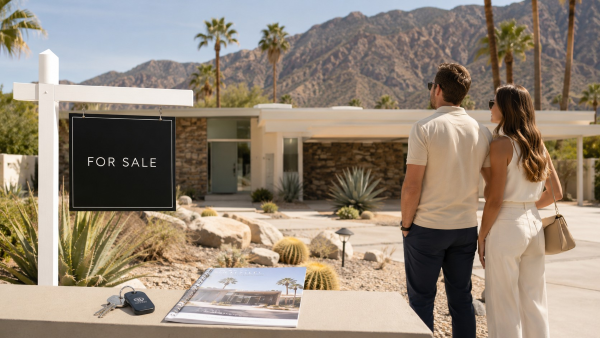
For Palm Springs home buyers, the current market presents a frustrating tradeoff: financing remains expensive, but negotiating conditions have improved.
Higher mortgage rates have reduced the number of people who are able—or willing—to purchase a home. Qualified buyers may therefore encounter:
- More Palm Springs homes for sale
- Fewer bidding wars
- More time to compare properties
- Greater inspection leverage
- More price reductions
- Sellers who are increasingly open to concessions
Depending on the home and the seller’s circumstances, a buyer may be able to negotiate a lower purchase price, closing-cost assistance, repair credits, or a contribution toward a mortgage-rate buydown.
A buyer may also be able to negotiate the inclusion of furnishings, which can be particularly valuable when purchasing a second home or vacation property in Palm Springs.
Properties that have been on the market for an extended period may offer especially good opportunities.
A seller who has already purchased another home, inherited the property, owns a vacant residence or simply wants to move forward may be more flexible than a seller who is merely testing the market.
Should Palm Springs Buyers Wait for Mortgage Rates to Fall?
Buyers should not purchase a home they cannot comfortably afford based on the assumption that mortgage rates will quickly decline.
The familiar expression “marry the house and date the rate” only makes sense when the buyer can afford the original monthly payment.
Refinancing may eventually become possible, but its timing is uncertain. It should be viewed as a potential future benefit—not as the foundation of a real estate purchase.
At the same time, waiting for mortgage rates to fall can also backfire.
If rates eventually decline, more buyers may return to the Palm Springs housing market. That could increase competition, reduce sellers’ willingness to negotiate, and place upward pressure on desirable home prices.
A buyer who negotiates a favorable purchase price today may have an opportunity to refinance later. A buyer who waits may obtain a lower mortgage rate but face more competition and pay a higher price for the same property.
There is no universal best time to buy Palm Springs real estate.
However, buyers with stable income, sufficient reserves, and a long-term ownership plan may find that a slower market provides opportunities that could disappear once consumer confidence improves.
Waiting may be appropriate when a buyer’s employment is uncertain, the down payment is inadequate or the proposed monthly payment would leave too little room for repairs and emergencies.
No buyer should stretch beyond a comfortable budget out of fear that they will miss the market.
What the Current Palm Springs Market Means for Sellers
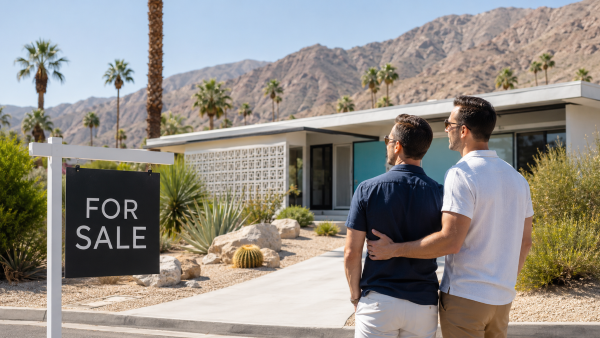
The message for Palm Springs home sellers is less comfortable.
This is generally not a market in which an owner can choose an ambitious price and simply wait for a buyer to accept it.
Today’s buyers are highly sensitive to monthly expenses. They are comparing more homes, taking longer to decide, and examining property condition, insurance costs, HOA dues, land-lease payments, and future maintenance.
A Palm Springs home that appears overpriced or requires substantial work may be passed over entirely.
Sellers need to be flexible—not necessarily desperate, but realistic.
That may mean pricing closer to recent comparable sales rather than relying on the highest neighborhood sale from several years ago.
It may also mean:
- Accepting a reasonable offer below the asking price
- Completing necessary repairs
- Offering a credit for deferred maintenance
- Contributing toward the buyer’s closing costs
- Helping fund a mortgage-rate buydown
- Including furnishings when appropriate
- Adjusting the closing date to meet the buyer’s needs
The market is not saying a well-maintained Palm Springs home has no value. It is saying buyers have more choices and expect pricing to reflect current economic and financing conditions.
Why the First Weeks of a Palm Springs Listing Matter
The first few weeks on the market are usually when a new listing receives its highest level of attention.
An inflated asking price can cause a home to miss that initial opportunity.
Repeated price reductions may eventually result in a sale, but they can also cause buyers to wonder whether something is wrong with the property or whether the seller will become even more negotiable later.
Sellers should remember that buyers can see a property’s listing history. A home that begins significantly above market value and later receives multiple reductions may attract lower offers than it would have received if it had been priced correctly from the start.
In a slower Palm Springs real estate market, successful selling requires more than putting a property in the MLS.
Preparation, staging, professional photography, strategic digital marketing, accurate pricing, and prompt responses to buyer feedback all matter.
Should I Sell My Palm Springs Home Now or Wait?
This is one of the most common questions Palm Springs homeowners are asking in 2026.
The honest answer is that market conditions could improve—but there is no guarantee that meaningful improvement will arrive soon.
Mortgage rates could decline if inflation moderates, energy prices fall, or the economy weakens. But higher oil prices and renewed inflation concerns make immediate, substantial rate cuts less likely.
Waiting six months or a year could create a better selling environment. It could also produce little change—or introduce new economic uncertainty.
Sellers should begin with a practical question:
What will waiting allow me to accomplish, and what will waiting cost me?
Waiting may make sense when the owner:
- Has no immediate reason to move
- Enjoys and regularly uses the home
- Has manageable ownership expenses
- Has a very low mortgage rate
- Is willing to accept that market conditions may not improve quickly
Selling a Palm Springs property now may make more sense when the home is:
- Vacant or rarely used
- Expensive to carry and maintain
- Creating financial or emotional stress
- Preventing a relocation or retirement plan
- Part of an estate that needs to be settled
- No longer appropriate for the owner’s lifestyle
- Keeping the owner from moving closer to family
A seller may not receive the price they imagined during the peak market. But holding out for an uncertain future has a cost.
Property taxes, insurance, utilities, repairs, landscaping, pool service, HOA dues, and mortgage payments can consume some—or all—of the additional proceeds a seller hopes to gain by waiting.
There is also an emotional cost to remaining in limbo.
Sometimes accepting a realistic market price is not the same as giving a home away. It is exchanging the property for the ability to move forward with life.
Will the Palm Springs Real Estate Market Improve Soon?
There are reasons to believe market conditions will eventually improve.
Wars end. Energy markets adjust. Inflation can moderate. Interest-rate cycles change.
However, “eventually” does not necessarily mean “soon.”
As of July 2026, there is no clear indication that mortgage rates are about to return to the exceptionally low levels available during the pandemic. Those rates resulted from extraordinary economic conditions and should not be treated as the normal standard.
Mortgage rates could gradually move lower if inflation cools and the Federal Reserve becomes more comfortable easing monetary policy.
But even lower mortgage rates would not benefit every participant in the same way.
Lower rates could bring more buyers into the Palm Springs housing market. That would improve demand for sellers, but it could also reduce buyers’ negotiating leverage.
Buyers might obtain a lower mortgage rate but face more competition and higher purchase prices.
Sellers might gain access to a larger pool of purchasers but also compete with other Palm Springs homeowners who delayed listing their properties while waiting for the same improvement.
No one can reliably predict the exact month when the market will shift.
Real estate decisions should therefore be based primarily on personal circumstances, financial capacity, and life goals—not solely on forecasts about oil prices or interest rates.
Opportunities for Palm Springs Home Buyers in 2026
A difficult market does not mean there are no opportunities.
For buyers, the current Palm Springs real estate market may offer:
- A larger selection of available homes
- More time to evaluate each property
- Fewer multiple-offer situations
- Greater leverage during inspections
- Opportunities to negotiate below the asking price
- Seller-paid closing costs or rate buydowns
- Better terms on homes that have been listed for an extended period
The best opportunities may not always be the properties with the largest advertised price reductions.
An experienced Palm Springs real estate agent can examine the listing history, comparable sales, ownership expenses, property condition, and seller motivation to determine whether a home represents genuine value.

What Palm Springs Sellers Need to Do in 2026
For sellers, success is more likely to come from strategy than from simply waiting.
A successful Palm Springs home sale in the current market may require:
- Pricing based on recent comparable sales
- Preparing the property before it is listed
- Addressing visible deferred maintenance
- Improving curb appeal and outdoor presentation
- Using professional photography and video
- Marketing beyond the local MLS
- Reaching second-home and out-of-area buyers
- Monitoring showing activity and buyer feedback
- Adjusting quickly when the market does not respond
- Remaining flexible during negotiations
Palm Springs is not one uniform housing market.
A midcentury home in Racquet Club Estates may appeal to a different buyer than a condominium in South Palm Springs, a luxury estate in Old Las Palmas or a retirement property in the greater Coachella Valley.
The marketing, pricing, and preparation strategy should reflect the specific home, neighborhood, and likely buyer.
A Real Estate Decision Is Also a Life Decision
Markets like this can feel discouraging because neither side receives everything they want.
Buyers may gain negotiating power, but they must accept higher financing costs.
Sellers may still achieve a successful sale, but they must compete for a smaller pool of qualified buyers and remain open to negotiation.
The key is to make decisions based on today’s reality rather than waiting for the Palm Springs housing market to recreate the conditions of 2020 or 2021.
No one can consistently identify the exact top or bottom of a real estate cycle.
Buyers and sellers can, however, evaluate their finances, their timeline, and what they want life to look like after the transaction.
A home is an investment, but it is also where life happens.
Sometimes the best decision is not the one that produces the highest theoretical return. It is the decision that allows you to comfortably purchase the home you want, sell a property that no longer serves you, or move forward with the next stage of life.
Get Local Palm Springs Real Estate Guidance
Online housing statistics can provide a broad picture, but they do not determine the value or marketability of an individual Palm Springs property.
Market conditions can differ considerably by neighborhood, property type, architectural significance, condition, price range, land ownership, and HOA structure.
The Paul Kaplan Group has helped buyers and sellers navigate Palm Springs and Coachella Valley real estate through changing markets since 2000. Our team specializes in Palm Springs homes, midcentury modern properties, architectural real estate, condominiums, second homes, retirement communities, and lifestyle-focused moves throughout the desert.
Whether you are wondering whether now is a good time to buy a home in Palm Springs, considering selling a Palm Springs property or trying to decide whether waiting could improve your outcome, the first step is understanding your specific circumstances and the current value of the property.
The Paul Kaplan Group can provide a neighborhood-specific market analysis, explain current buyer behavior, and help you weigh the financial and personal advantages of acting now versus waiting.
Important Real Estate and Financial Disclaimer
This article is provided by the Paul Kaplan Group for general informational and educational purposes only. It is not intended to constitute financial, investment, tax, legal, lending, or individualized real estate advice.
Economic conditions, mortgage programs, insurance requirements, and real estate markets can change quickly. Every buyer’s, seller's, and investor’s financial circumstances are different.
*Readers should consult with their own qualified financial advisor, attorney, tax professional, insurance representative, lender, and licensed real estate professional before making any real estate purchase, sale, or investment decision. Past market performance does not guarantee future results, and no forecast of home values, mortgage rates, or economic conditions can be guaranteed.
Resources Used in Preparing This Article
The following organizations and publications were consulted when researching the economic, mortgage, and Palm Springs housing information discussed in this article:
- Board of Governors of the Federal Reserve System: June 17, 2026 Federal Open Market Committee statement and supporting monetary policy information. (Federal Reserve)
- Freddie Mac Primary Mortgage Market Survey: National average mortgage-rate data through July 16, 2026. (Freddie Mac)
- U.S. Energy Information Administration: Research concerning the Strait of Hormuz and major global oil-transit chokepoints. (U.S. Energy Information Administration)
- Redfin: Palm Springs median home-sale price, sales activity, and average market-time data through May 2026. (Redfin)
- Zillow: Palm Springs inventory, median sale price, sale-to-list ratio, and percentage of sales below the asking price. (Zillow)
- Reuters: Reporting on the national housing market, mortgage rates, inflation, and the economic effects of geopolitical tensions. (Reuters)
Selling Your Home?
Get your home's value - our custom reports include accurate and up to date information.